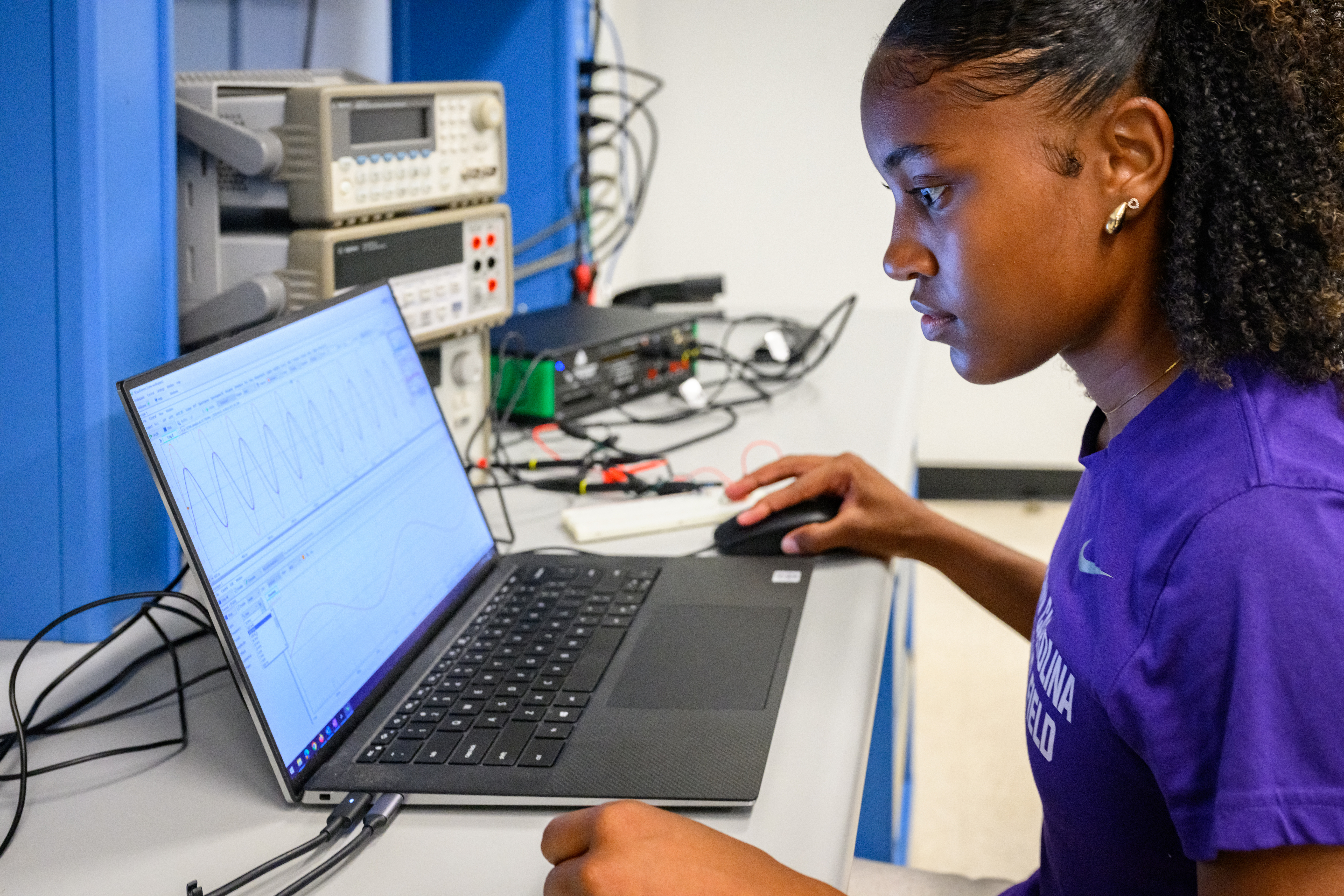
$35K URPA grant will support engineering students to develop AI manufacturing skills
Abdallah Abdallah, an associate professor in 甜瓜视频app鈥檚 College of Engineering and Technology, has received the UNC System Office鈥檚 Undergraduate Research Program Award, a $35,000 grant that allows students to gain experience that will benefit their academic and professional careers.

The URPA grant will fund student research surrounding AI in smart manufacturing and will help WCU鈥檚 engineering students bridge the gap between the classroom and the workforce.
Factories and warehouses already have automated vehicles loading and unloading packages and robotic arms performing repetitive tasks, which is creating a need for a workforce that has the skills to program, troubleshoot, and maintain these technologies. Providing relevant industry skills to students is all the more prescient during a time when manufacturing practices are shifting to involve smart technology and AI. Known as Industry 4.0, this AI-driven industrial revolution has already arrived.
Abdallah will teach a special topics course titled 鈥淎I and Computer Vision for Smart Manufacturing鈥� in the spring of 2026. Students will learn to program robotic arms to detect, identify, and sort objects traveling along a conveyor belt based on color and shape. Using cameras and programmable robotic arms, students will learn how to utilize these integrated systems within the manufacturing process, gaining insight into how AI can automate classification and sorting tasks in modern production lines. This is applicable across concentrations, as this technology has tie-ins with electrical, mechanical, and computer engineering.
During the summer, students from the course will be selected to expand and continue the project. They will work to develop and integrate AI-based control algorithms to program the robotic arms for additional functions.
鈥淥ther uses would be defect detection,鈥� Abdallah said. 鈥淔or example, two robot arms collaborate on a task. One arm is picking up the defective one, but it is not throwing them away. It鈥檚 giving them to another robot that's doing some other thing with them.鈥� This will then be used to create hardware and software modules that will develop instructional materials for a new course titled 鈥淓mbedded Robotic Systems.鈥�
WCU's emphasis on project-based learning helps students gain real-world experience that directly translates to everyday scenarios in the workforce. 鈥淲CU is famous for project-based learning,鈥� Abdallah explained. 鈥淲e have four different levels of PBL classes. Even engineering programs that have ranked in U.S. news rankings have freshman PBL, and they have capstones. They don't have sophomore or junior PBL.鈥�
This project aligns with WCU鈥檚 Engineering Expansion Plan, where the Belk building will undergo renovations to become a state-of-the-art facility and a center for engineering education in the western part of the state. As part of this, WCU will be acquiring a standard manufacturing robotic arm setup, with the goal of giving students experience working with relevant technology and brands.
鈥淪tudents won't just have prototyping experience. Now they're ready to go say 鈥業 actually know how to program this and do this,鈥� Abdallah said. His goal is to continue this project and continue to find ways to fund student research projects on industry-grade manufacturing machines.
鈥淲CU can really be such a hub for the area in terms of smart manufacturing and hiring summer research interns.鈥� Abdallah鈥檚 enthusiasm for teaching is palpable, and he himself is an assembly line pushing out idea after idea to help his students gain knowledge and valuable skills.