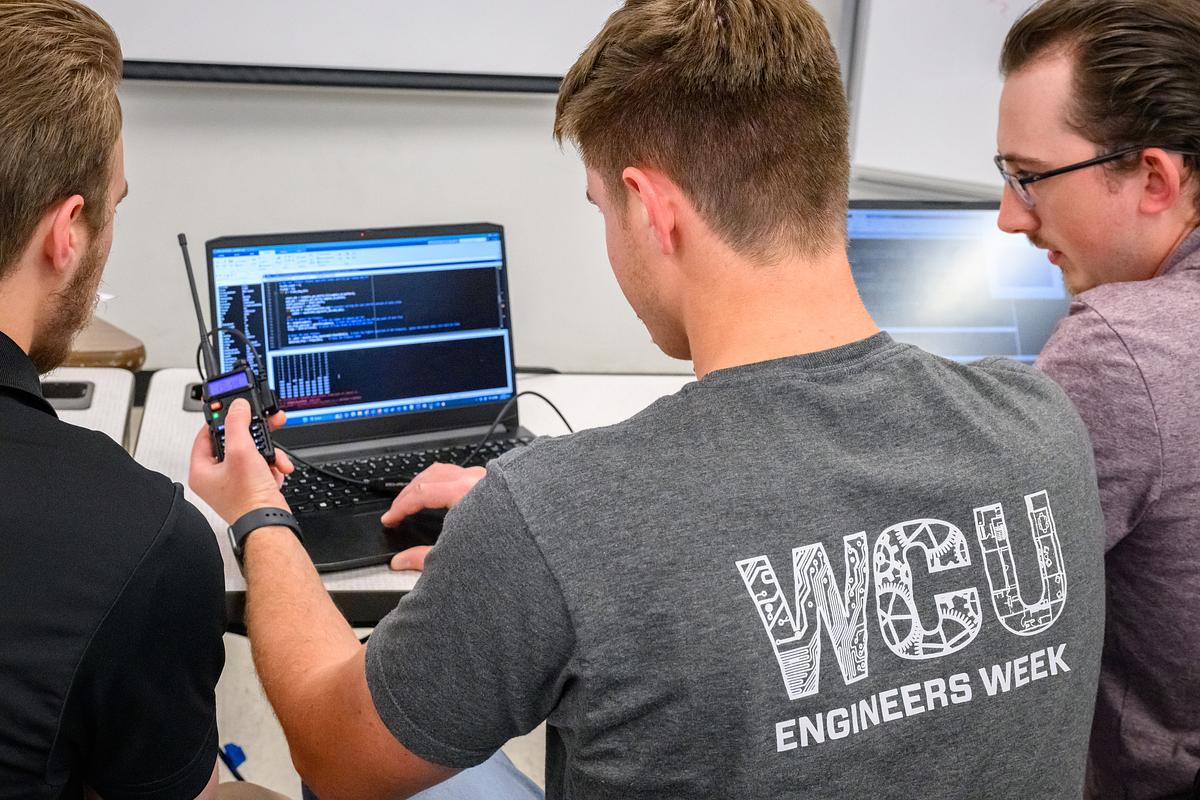
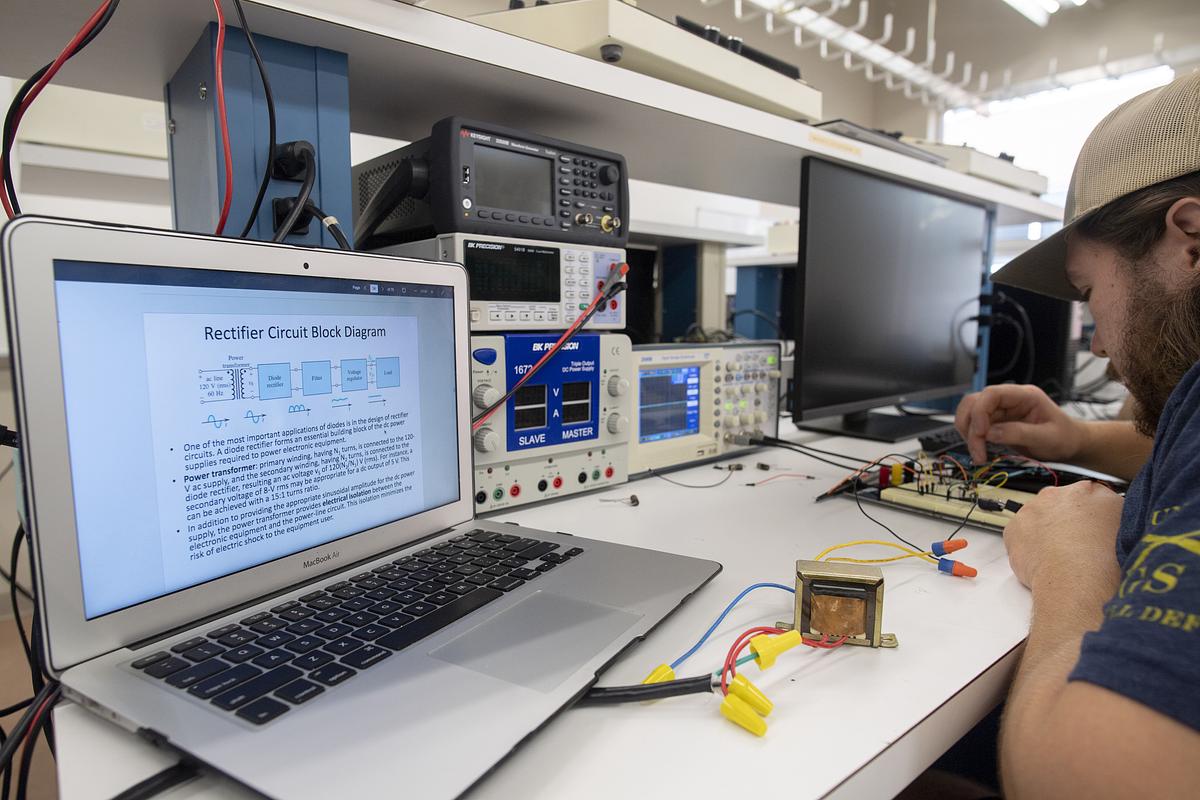
Students enrolled in the 甜瓜视频app Electrical Engineering Program
share a love of math, strong study habits, the ability to visualize abstract concepts,
and a willingness to explore new frontiers. Accredited by the Engineering Accreditation
Commission (EAC) of ABET, the program prepares graduates for employment in professional
areas such as engineering design, modeling, prototyping, fabrication and testing and
the possibility of continuing their education in graduate school. Students immerse
themselves in our Project-based learning (PBL) approach, learning from expert, experienced
faculty in both classroom and lab experiences using sophisticated equipment that meets,
or exceeds, industry standards. Almost a third of the program鈥檚 students are members
of The Brinson Honors College.
The program curriculum combines engineering courses with complementary coursework
to ensure electrical engineering graduates are well-rounded individuals able to work
effectively in team environments and adapt to different work environments. The curriculum
emphasizes engineering design with applications of mathematics and sciences, and professional
skills such as communication skills, professional and ethical responsibility, and
contemporary issues. All students are required to participate in a two-semester senior
capstone project for industrial sponsors under the guidance of faculty members and
industry mentors who excel in many areas.
Where You'll Go
Program graduates find work in design, manufacturing, medical, local utility, communications,
aerospace and transportation industries. Career specialties include instrumentation
specialization, control system consultation, engineering specialization, and packaging,
test and electrical engineering, among others. Many graduates, particularly those
interested in running their own businesses, choose to enroll in graduate studies to
deepen their knowledge and further expand their career possibilities.
Electrical Engineering (EE) is a challenging and rewarding course of study that requires
a love of math, strong study habits and the ability to visualize abstract concepts.
The WCU College of Engineering's EE program is made up of like-minded students in small classes with faculty who
have a thorough knowledge of the topics they are teaching as well as practical experience
in their fields.
Explore cutting-edge topics like semiconductor devices, electromagnetics, control
systems, signal processing and analysis, and communications.
Dive deeper into electrical power and clean energy systems, and topics such as electromechanical
energy conversion, power electronics, and power converters.
Bridge hardware and software as you delve into the design, implementation, and integration
of digital components, embedded systems, and both conventional and smart digital devices.
The primary mission of the EE program is to produce well-educated graduates who are
employable in professional areas such as electrical engineering design and analysis
of electrical and photonic products and systems. Graduates may also continue their
education at the graduate level.
Academic accreditation plays a vital role in ensuring our programs meet rigorous standards
of quality and excellence.
Transfer as seamlessly as possible from a community college or other institution to
one of the College of Engineering's degree programs.
What鈥檚 Happening
AUG
04
AUG
06
AUG
08
Related Programs
Explore our related programs until you find the one that鈥檚 right for you.